A commercial inspection report is most useful when it turns a walk-through into a defensible decision. The following example commercial inspection report findings show how clear documentation can identify current concerns, distinguish maintenance needs from time-sensitive risks, and give owners, buyers, and property managers a practical path forward.
For a retail center, medical office, warehouse, or multifamily property, the value is not in receiving a long list of defects. It is in understanding where the condition exists, what evidence supports the finding, what may happen if it is deferred, and what type of qualified professional should evaluate or correct it. Good reporting replaces assumptions with visible, organized information.
What a Commercial Inspection Finding Should Include
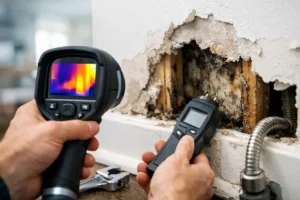
A meaningful finding does more than state that something is damaged or worn. It should identify the observed condition, its location, the likely consequence, and a recommendation proportionate to the issue. High-resolution photographs, thermal imaging where appropriate, moisture readings, and clear location references help a client verify what was observed without revisiting every area of the property.
The language also matters. An inspector reports observable conditions and explains why they merit attention. A report should not imply that every issue requires immediate replacement, nor should it minimize conditions that could lead to water intrusion, business interruption, occupant safety concerns, or escalating repair costs.
The examples below illustrate the level of detail decision-makers should expect.
Example Commercial Inspection Report Findings by System
Roof covering shows active maintenance concerns
Observed condition: Multiple areas of the low-slope roof covering displayed open seams, deteriorated sealant at penetrations, and localized ponding near rooftop equipment. Interior staining was visible on ceiling finishes below one affected area. The roof surface was inspected from accessible areas only.
Why it matters: Open seams and failed sealant can allow water to enter the building envelope. Ponding water may accelerate material deterioration and can make small defects more consequential during prolonged rain. Interior staining confirms that moisture has reached finishes, although the full extent of concealed damage cannot be determined through a visual inspection alone.
Recommended action: Have a qualified roofing contractor evaluate the roof covering, penetrations, drainage paths, and affected interior areas. Obtain a repair scope that addresses active defects first, then use the contractor’s assessment to plan remaining service life and future capital expenditures.
This type of finding is especially valuable during an acquisition. A roof may not need full replacement today, but a buyer needs enough evidence to budget realistically and negotiate from facts rather than general statements about age.
HVAC equipment is operating with deferred maintenance indicators
Observed condition: Several rooftop HVAC units were operating at the time of inspection. However, one unit produced noticeably reduced airflow, corrosion was present at portions of the cabinet, and a condensate drain line lacked secure support. Service labels indicated no recent documented maintenance on two units.
Why it matters: Reduced airflow can affect comfort, tenant satisfaction, and equipment efficiency. An unsecured condensate line can leak onto roof surfaces or into occupied areas depending on its routing. Corrosion does not automatically mean the equipment has failed, but it is a condition that warrants closer review when planning maintenance or replacement cycles.
Recommended action: Request evaluation and servicing by a licensed HVAC contractor. The service should address airflow performance, drainage, electrical components, refrigerant-related conditions, and maintenance history. The report should clearly separate equipment that is functioning but needs service from equipment that has reached the end of a reasonable planning horizon.
Electrical panel contains conditions requiring correction
Observed condition: An electrical panel had open knockouts, incomplete circuit identification, and evidence of corrosion at the lower cabinet area. One unused opening was not properly covered. No destructive testing or load calculation was performed.
Why it matters: Openings in electrical enclosures can expose internal components to dust, moisture, or accidental contact. Poor circuit labeling slows emergency response and complicates future maintenance. Corrosion may indicate past moisture exposure and should be evaluated to determine whether active water entry remains present.
Recommended action: Have a qualified electrical contractor correct enclosure openings, update circuit identification, and evaluate the corroded area and nearby moisture source. If the property will undergo a change in use, expansion, or equipment upgrade, the owner should also confirm whether the existing electrical capacity supports the intended demand.
A precise report avoids declaring an entire electrical system inadequate based on one observed panel condition. It documents the condition, notes the limitations of the inspection, and identifies the appropriate next step.
Moisture was detected at exterior wall finishes
Observed condition: Elevated moisture readings were obtained at portions of an exterior wall below window assemblies. Sealant at several window perimeters was cracked or separated. Interior finishes in the corresponding area showed minor discoloration and softening at the baseboard.
Why it matters: Failed perimeter sealant can permit water to move behind exterior finishes and into wall cavities. Even a small visible stain may represent a larger concealed area, particularly where water has been entering over multiple weather cycles. Left unaddressed, moisture can damage finishes, insulation, framing components, and indoor air quality.
Recommended action: Have a qualified building-envelope contractor evaluate window flashing, sealant joints, exterior finishes, and the extent of moisture-related damage. Repair work should address the entry point first. Replacing interior finishes before correcting the water source can result in repeat damage.
This is where thermal imaging and moisture detection can add practical value. These tools do not see through walls or diagnose every concealed condition, but they can help identify areas that deserve more focused evaluation.
Plumbing leakage is affecting a tenant space
Observed condition: Active dripping was observed at a supply connection beneath a break-room sink. Moisture staining and swollen cabinet materials were present below the connection. A nearby wall finish showed discoloration at the lower section.
Why it matters: Small plumbing leaks can become expensive when they occur in occupied spaces. Beyond cabinet damage, prolonged moisture can affect adjacent finishes and may interrupt tenant operations if repairs require access to concealed piping.
Recommended action: Arrange prompt repair by a qualified plumbing contractor and evaluate the affected cabinet, wall finish, and floor area after the leak is corrected. If the property has similar fixtures installed at the same time, a manager may also choose to inspect comparable connections as part of preventive maintenance.
Site drainage directs water toward the building
Observed condition: Portions of paved parking and landscape areas appeared to slope toward the building perimeter. Sediment accumulation was observed at several catch basins, and one downspout discharged near the foundation wall without a functional extension.
Why it matters: Water that collects against a building can contribute to moisture entry, deterioration of exterior finishes, icy walkways, and premature wear at pavement and drainage components. Drainage concerns are often gradual, which makes them easy to overlook until a heavy storm exposes the problem.
Recommended action: Have a qualified site or drainage contractor clean catch basins, evaluate grading and discharge locations, and recommend improvements that move water away from the building. The appropriate solution depends on site layout, existing drainage infrastructure, local requirements, and the severity of observed ponding.
How to Read Priorities in a Commercial Report
Not every finding carries the same urgency. A useful report helps readers separate immediate risk from planned maintenance. Active water entry, exposed electrical components, trip hazards, and inoperative life-safety features generally warrant faster action than cosmetic deterioration or equipment that remains functional but is approaching a maintenance threshold.
Priority also depends on the property and the transaction. A condition that is manageable for an owner with a maintenance team may be a significant concern for a buyer who is setting first-year operating reserves. Likewise, a minor leak in an unoccupied suite may require a different response than the same leak above a server room, medical practice, or restaurant.
The strongest reports also acknowledge limits. Areas behind finishes, above inaccessible ceilings, inside equipment housings, and below ground are not fully visible during a standard inspection. When findings suggest a concealed concern, the report should recommend further evaluation rather than overstate certainty.
Turning Findings Into Better Property Decisions
Once the report is delivered, convert it into an action plan. Address active safety and water-related conditions first, obtain specialist opinions where needed, then organize remaining items into near-term repairs, routine maintenance, and longer-range capital planning. Photographs and location-specific notes make this process easier to assign, price, and track.
For buyers, documented findings can support due diligence, repair negotiations, and reserve planning. For owners and managers, the same information can reduce reactive maintenance and create a clearer record of property condition over time. Archer Professional Inspections approaches reporting with this decision-support purpose in mind: clear evidence, practical recommendations, and no unnecessary alarm.
A commercial property does not need to be perfect to be a sound investment. It needs to be understood. When a report explains conditions clearly enough to guide the next decision, it becomes more than an inspection document – it becomes a useful operating tool.