A ceiling stain may be dry to the touch, a bathroom wall may look perfectly finished, and a flat roof may show no obvious interior damage. That is where thermal scan vs moisture testing becomes more than a technical comparison. These methods help an inspector investigate conditions that visual observation alone cannot confirm – but they do not provide the same type of evidence.
For property buyers, owners, managers, and investors, the distinction matters. A thermal image can identify an area that deserves closer attention. Moisture testing can help determine whether materials are currently holding elevated moisture. Used correctly, the two methods reduce guesswork and support better decisions about repairs, maintenance, negotiations, and further evaluation.
Thermal Scan vs Moisture Testing: The Core Difference
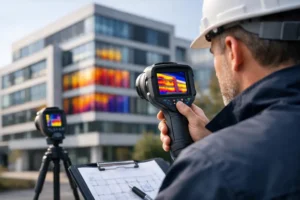
A thermal scan uses an infrared camera to display surface temperature patterns. The camera does not see through walls, detect water directly, or diagnose the source of a problem. It records differences in infrared energy that appear as warmer or cooler areas on an image.
Those temperature differences can be meaningful. An area affected by evaporation may appear cooler than surrounding materials. Missing or displaced insulation can create a distinct temperature pattern. Air movement around an opening, electrical components operating at unusual temperatures, and sun exposure can also create visible anomalies.
Moisture testing, by contrast, uses a moisture meter or probe to assess the moisture condition of a material. Depending on the instrument and testing method, the inspector may take a noninvasive reading at the surface or use probes to test below the surface. The result is not always a universal percentage of water content. Many readings are relative, material-specific, and interpreted in comparison with nearby dry areas.
In plain terms, thermal imaging identifies a pattern that may be consistent with moisture. Moisture testing provides a more direct way to verify whether elevated moisture is present at the tested location.
What a Thermal Scan Can Reveal
Thermal imaging is valuable because it quickly surveys broad areas without removing finishes. During a property inspection, it may help identify cooler areas below a roof covering, around a window, under a plumbing fixture, or along an exterior wall. It can also reveal conditions unrelated to water, such as insulation gaps or air leakage paths.
That broad-view capability makes thermal scanning especially useful for prioritizing the inspection. Rather than relying only on a visible stain or a homeowner’s description of a past leak, the inspector can compare adjacent surfaces and look for patterns that warrant confirmation.
A high-quality thermal image is not meaningful by itself, however. Its value depends on the conditions present during the inspection and the experience of the person interpreting it. Temperature differences need a cause. For example, a cool spot on a wall may be caused by dampness, but it may also result from an HVAC supply duct, a shaded exterior surface, recently operated plumbing, or a framing member with different thermal properties.
Conditions That Affect Thermal Imaging
Thermal cameras work best when there is enough temperature contrast between the area being evaluated and its surroundings. A recent rain event, active plumbing use, heating or cooling operation, exterior sun exposure, and time of day can all affect what the camera shows.
This is why an inspection report should not treat every thermal anomaly as proof of a leak. The finding should describe the observed pattern, its location, related visible evidence, and whether moisture readings or other follow-up support the concern. Clear documentation protects the client from both missed conditions and overconfident conclusions.
What Moisture Testing Can Confirm
Moisture testing is often the next step when a thermal scan identifies an unusual temperature pattern or when visible signs point to possible water intrusion. Inspectors may test drywall, trim, flooring, ceilings, cabinetry, roof decking where accessible, and other materials that could retain moisture.
The most useful readings are comparative. A single number means little without context. An inspector may test the suspect location, then compare it with similar nearby areas that appear unaffected. If readings are materially higher in the suspect area, that supports the possibility of moisture exposure.
Moisture testing can be particularly helpful when evaluating a discoloration, soft finish material, musty odor, plumbing-adjacent surface, or area below a roof penetration. It can help distinguish between an old, dry stain and a condition that appears active or recently active.
Still, moisture meters have limits. Dense materials, metal behind a finished surface, salts, surface condensation, and certain coatings can affect readings. Pinless meters typically assess moisture within a limited depth and across a wider area, while pin-type meters provide localized readings at the probe points. The appropriate method depends on the material, accessibility, and purpose of the evaluation.
Why One Method Alone Can Miss the Full Picture
A thermal scan alone can produce a compelling image without confirming moisture. That image may correctly show a temperature difference, yet the underlying cause may be unrelated to water. Acting on the image alone can lead to unnecessary concern or poorly targeted repairs.
Moisture testing alone can also be incomplete. A meter tests only the locations selected by the inspector. If the affected area extends beyond an obvious stain, a broader thermal survey may help identify where additional readings should be taken. In some situations, moisture may be present deeper within an assembly than the meter can effectively assess from the accessible surface.
The strongest approach is usually a layered investigation: visual observations, client-provided history, thermal imaging when conditions allow, targeted moisture readings, and documentation of relevant limitations. This process does not eliminate every uncertainty, but it creates a more reliable basis for decisions than any single tool can provide.
When Thermal Imaging Is Most Useful
Thermal scanning is a practical choice when an inspector needs to evaluate a large area efficiently or investigate a concern without immediately disturbing finished materials. It can be useful around roof and ceiling areas, exterior openings, plumbing fixtures, electrical panels, HVAC components, and insulation transitions.
It is also beneficial in commercial properties, where repetitive building features and large wall or ceiling areas can make visual-only review less efficient. A thermal scan can help focus attention on areas that may need closer examination, maintenance planning, or additional specialized assessment.
The key is setting the right expectation: infrared imaging is a screening and investigative tool, not an X-ray. It can direct attention to patterns that deserve answers.
When Moisture Testing Is the Better First Step
When there is a visible stain, material deterioration, an accessible leak source, or a specific complaint about a wet area, moisture testing may be the most direct starting point. It can provide immediate evidence about the condition of accessible materials and help establish whether the concern appears localized or more widespread.
A meter is also useful for rechecking an area after a reported repair. While a dry reading does not guarantee that every concealed surface is unaffected, comparative readings can help document current conditions at the time of the inspection.
For buyers and investors, this distinction is practical. A thermal image may explain why an inspector recommends further investigation. Moisture readings may help support the urgency of addressing the issue before closing or before authorizing repairs.
What Good Documentation Looks Like
Tools matter, but reporting matters just as much. A useful inspection report should connect the evidence to the decision at hand. That means identifying the exact location, describing visible conditions, including representative photographs or thermal images when relevant, recording moisture readings with context, and explaining the recommended next step.
A report should also state what was and was not accessible. Finished wall cavities, concealed roof areas, and materials behind fixed equipment cannot always be fully evaluated without invasive work. Clear limitations are not a weakness in the report. They show that the inspector is distinguishing observed evidence from conditions that require additional evaluation.
At Archer Professional Inspections, advanced diagnostic tools are used to strengthen the on-site assessment and provide clients with clear, decision-support documentation. The goal is not to create alarm from a colorful image or an isolated meter reading. It is to identify credible concerns, document them accurately, and help clients understand what action is reasonable.
Choosing the Right Method for Your Property Concern
The choice between a thermal scan and moisture testing depends on the question being asked. If the concern is broad or the possible affected area is unknown, thermal imaging can help locate patterns for further investigation. If the concern is a specific stain, suspected plumbing leak, or damaged finish, moisture testing may provide faster confirmation at the accessible surface.
In many inspections, the right answer is both. Thermal imaging helps identify where the investigation should go. Moisture testing helps test whether a moisture-related explanation is supported. Together with careful visual inspection and well-organized reporting, they turn a vague concern into evidence you can use.
When a property decision depends on what may be hidden behind a finished surface, ask not only whether an inspector uses advanced tools, but how the findings will be interpreted and documented. The value comes from disciplined investigation – and from receiving clear information before a small uncertainty becomes an expensive surprise.