Best Commercial Building Due Diligence Questions

A commercial property can appear well maintained during a walkthrough and still carry years of deferred repairs, water intrusion, aging equipment, or compliance exposure. The best commercial building due diligence questions move the conversation beyond curb appeal and asking price. They help buyers, lenders, investors, and property managers identify what the building needs now, what it is likely to need next, and what documentation supports those conclusions.

A careful due diligence process is not about finding a reason to walk away from every deal. It is about replacing assumptions with documented facts. A clear property condition assessment can turn an unknown repair risk into a budget item, a negotiation point, or a planned improvement.

Start With the Building’s Real Operating History

Before focusing on individual systems, establish how the property has been used and maintained. A warehouse, medical office, retail center, and multifamily property can have very different wear patterns even when they are the same age. Ask the owner or manager how occupancy has changed, whether spaces have been renovated, and whether the building has experienced flooding, leaks, fires, storm damage, or extended vacancies.

Maintenance records matter as much as verbal answers. Request service histories, warranties, invoices, capital improvement records, utility bills, permits, prior inspection reports, and open work orders. Missing records do not automatically mean poor conditions, but they do increase uncertainty. That uncertainty should be reflected in the scope of further evaluation, the purchase terms, or the capital reserve.

Best Commercial Building Due Diligence Questions to Ask

1. What is the condition and expected service life of the roof?

Roof replacement can be one of the largest near-term capital expenses in a commercial acquisition. Ask when the roof was installed, whether it has been repaired, who performed the work, and whether transferable warranties exist. A roof may have no visible active leak during a dry site visit but still show aging seams, ponding, damaged flashing, or previous patching that points to a shorter remaining service life.

Also ask whether rooftop equipment service has caused damage around penetrations. The condition of drains, scuppers, gutters, and downspouts deserves the same attention. Water that cannot leave the roof properly often finds another path into the building.

2. Where has water entered the building, and what was done to correct it?

Water intrusion is not limited to a visible ceiling stain. It can affect exterior walls, window openings, below-grade areas, floor finishes, insulation, and concealed materials. Ask for the location, frequency, and date of every known leak, as well as the repair performed and whether the area was retested afterward.

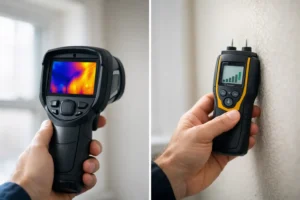
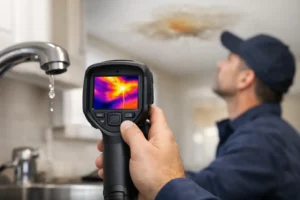
A thorough assessment should look for current moisture conditions and evidence of recurring water movement. Thermal imaging and moisture detection can help identify concerns that are not obvious to the eye, particularly around roof transitions, exterior openings, plumbing areas, and mechanical rooms.

3. Which building systems are nearing replacement or major repair?

Request the age, capacity, maintenance history, and known issues for heating, cooling, ventilation, electrical, plumbing, fire protection, elevators, and other property-specific equipment. The right question is not simply, “Does it work today?” It is, “What is likely to require significant spending during our ownership period?”

A system can be operating at the time of inspection while still having limited remaining life, outdated components, insufficient capacity, or a history of repeated repairs. For an investor, that difference can materially change projected returns. For an owner-occupant, it can affect business continuity and renovation planning.

4. Are there signs of deferred maintenance outside the building?

The site is part of the asset. Ask about pavement repairs, drainage performance, retaining features, sidewalks, exterior lighting, fencing, loading areas, landscaping, and site access. Poor drainage can contribute to moisture concerns, pavement deterioration, and unsafe walking conditions. Deteriorated parking areas or loading zones may also create liability concerns and disrupt tenant or customer access.

Pay attention to repairs that have been repeatedly patched rather than properly addressed. A series of small fixes can signal a larger issue that has not yet been budgeted.

5. Are there open permits, code issues, or unresolved notices?

Ask for records of permits, certificates of occupancy, inspection notices, fire department findings, accessibility concerns, and correspondence with local authorities. Confirm whether prior renovations were properly permitted and whether the current use matches approved occupancy.

A property condition assessment is not a substitute for every specialty or jurisdictional review. However, it can identify visible conditions and documentation gaps that warrant follow-up. That distinction matters: a buyer should understand both what was observed and what requires verification by the appropriate qualified professional or authority.

6. What repairs are tenant responsibilities, and what remains with the owner?

For leased commercial property, physical condition and lease obligations must be reviewed together. Ask who is responsible for maintaining the roof, HVAC equipment, plumbing fixtures, parking areas, and interior improvements. Review whether tenants have reported recurring problems, requested repairs, or been granted rent concessions related to building conditions.

A triple-net lease may shift certain costs to tenants, but it does not remove the owner’s exposure to a major building failure, a dispute over responsibility, or a vacant space requiring immediate work before reletting. The lease language, repair history, and observed conditions should tell a consistent story.

7. Have there been insurance claims or casualty events?

Request a history of claims involving water, wind, hail, fire, vandalism, or equipment failures. Ask whether repairs were completed, whether they were documented, and whether any claim was denied or only partially covered. This information can reveal recurring problems and help clarify whether a prior repair addressed the cause or only the visible damage.

Insurance history also supports more accurate risk planning. A property with repeated water claims may require closer investigation even if its finishes appear recently updated.

8. Are there environmental or health-related concerns to investigate?

Depending on the building’s age, location, and former use, due diligence may need to address asbestos-containing materials, lead-based paint, mold, radon, underground storage tanks, contamination, or indoor air quality concerns. Ask what prior testing has been completed and whether remediation records are available.

Not every property needs every test. The appropriate scope depends on the property type, construction era, site history, and visible conditions. The key is to identify potential concerns early enough to arrange the right specialty evaluation before contingencies expire.

9. What does the capital plan look like for the next five to ten years?

This question brings individual findings into a decision-making framework. Ask for a schedule of anticipated replacements, repairs, and upgrades, with estimated timing and costs. Separate immediate safety or water-management concerns from short-term repairs and longer-range capital projects.

A credible capital plan should not rely only on the seller’s estimates. It should be informed by observed conditions, equipment age, maintenance documentation, and the property’s intended use. If you plan to renovate, change occupancy, or improve energy performance, those goals should be reflected as well.

Ask for Evidence, Not Reassurance

Statements such as “it has always been fine” or “we have not had any problems” are useful context, but they are not verification. For major claims about repairs, replacements, warranties, or compliance, request invoices, reports, photos, permits, and service records. If documents are unavailable, treat the condition as unverified rather than assuming the best-case scenario.

The inspection report should also make its limits clear. Some areas may be inaccessible, concealed by finishes, occupied by tenants, or outside the agreed scope. Those limitations are not a reason to ignore the issue. They are a reason to decide whether additional access, testing, or specialty review is appropriate before finalizing the transaction.

Turn Findings Into a Better Property Decision

Due diligence works best when the inspection is scheduled early enough to allow time for follow-up. Avoid treating the site assessment as a last-minute checkbox. A detailed report with high-resolution visual documentation gives decision-makers a practical basis for negotiations, repair requests, reserve planning, and future maintenance.

For some properties, the findings may justify a price adjustment or seller repairs. For others, the better outcome is accepting known conditions with a realistic capital budget. The goal is not a perfect building. It is a clear understanding of the investment you are making and the obligations that come with it.

Archer Professional Inspections provides detailed commercial building evaluations designed to help clients document conditions, prioritize concerns, and move forward with greater confidence. The right questions, supported by careful on-site assessment, can prevent an expensive surprise from becoming a preventable one.

Related posts

Leave the first comment

Best Commercial Building Due Diligence Questions

A commercial property can appear well maintained during a walkthrough and still carry years of deferred repairs, water intrusion, aging equipment, or compliance exposure. The best commercial building due diligence questions move the conversation beyond curb appeal and asking price. They help buyers, lenders, investors, and property managers identify what the building needs now, what it is likely to need next, and what documentation supports those conclusions.

A careful due diligence process is not about finding a reason to walk away from every deal. It is about replacing assumptions with documented facts. A clear property condition assessment can turn an unknown repair risk into a budget item, a negotiation point, or a planned improvement.

Start With the Building’s Real Operating History

Before focusing on individual systems, establish how the property has been used and maintained. A warehouse, medical office, retail center, and multifamily property can have very different wear patterns even when they are the same age. Ask the owner or manager how occupancy has changed, whether spaces have been renovated, and whether the building has experienced flooding, leaks, fires, storm damage, or extended vacancies.

Maintenance records matter as much as verbal answers. Request service histories, warranties, invoices, capital improvement records, utility bills, permits, prior inspection reports, and open work orders. Missing records do not automatically mean poor conditions, but they do increase uncertainty. That uncertainty should be reflected in the scope of further evaluation, the purchase terms, or the capital reserve.

Best Commercial Building Due Diligence Questions to Ask

1. What is the condition and expected service life of the roof?

Roof replacement can be one of the largest near-term capital expenses in a commercial acquisition. Ask when the roof was installed, whether it has been repaired, who performed the work, and whether transferable warranties exist. A roof may have no visible active leak during a dry site visit but still show aging seams, ponding, damaged flashing, or previous patching that points to a shorter remaining service life.

Also ask whether rooftop equipment service has caused damage around penetrations. The condition of drains, scuppers, gutters, and downspouts deserves the same attention. Water that cannot leave the roof properly often finds another path into the building.

2. Where has water entered the building, and what was done to correct it?

Water intrusion is not limited to a visible ceiling stain. It can affect exterior walls, window openings, below-grade areas, floor finishes, insulation, and concealed materials. Ask for the location, frequency, and date of every known leak, as well as the repair performed and whether the area was retested afterward.

A thorough assessment should look for current moisture conditions and evidence of recurring water movement. Thermal imaging and moisture detection can help identify concerns that are not obvious to the eye, particularly around roof transitions, exterior openings, plumbing areas, and mechanical rooms.

3. Which building systems are nearing replacement or major repair?

Request the age, capacity, maintenance history, and known issues for heating, cooling, ventilation, electrical, plumbing, fire protection, elevators, and other property-specific equipment. The right question is not simply, “Does it work today?” It is, “What is likely to require significant spending during our ownership period?”

A system can be operating at the time of inspection while still having limited remaining life, outdated components, insufficient capacity, or a history of repeated repairs. For an investor, that difference can materially change projected returns. For an owner-occupant, it can affect business continuity and renovation planning.

4. Are there signs of deferred maintenance outside the building?

The site is part of the asset. Ask about pavement repairs, drainage performance, retaining features, sidewalks, exterior lighting, fencing, loading areas, landscaping, and site access. Poor drainage can contribute to moisture concerns, pavement deterioration, and unsafe walking conditions. Deteriorated parking areas or loading zones may also create liability concerns and disrupt tenant or customer access.

Pay attention to repairs that have been repeatedly patched rather than properly addressed. A series of small fixes can signal a larger issue that has not yet been budgeted.

5. Are there open permits, code issues, or unresolved notices?

Ask for records of permits, certificates of occupancy, inspection notices, fire department findings, accessibility concerns, and correspondence with local authorities. Confirm whether prior renovations were properly permitted and whether the current use matches approved occupancy.

A property condition assessment is not a substitute for every specialty or jurisdictional review. However, it can identify visible conditions and documentation gaps that warrant follow-up. That distinction matters: a buyer should understand both what was observed and what requires verification by the appropriate qualified professional or authority.

6. What repairs are tenant responsibilities, and what remains with the owner?

For leased commercial property, physical condition and lease obligations must be reviewed together. Ask who is responsible for maintaining the roof, HVAC equipment, plumbing fixtures, parking areas, and interior improvements. Review whether tenants have reported recurring problems, requested repairs, or been granted rent concessions related to building conditions.

A triple-net lease may shift certain costs to tenants, but it does not remove the owner’s exposure to a major building failure, a dispute over responsibility, or a vacant space requiring immediate work before reletting. The lease language, repair history, and observed conditions should tell a consistent story.

7. Have there been insurance claims or casualty events?

Request a history of claims involving water, wind, hail, fire, vandalism, or equipment failures. Ask whether repairs were completed, whether they were documented, and whether any claim was denied or only partially covered. This information can reveal recurring problems and help clarify whether a prior repair addressed the cause or only the visible damage.

Insurance history also supports more accurate risk planning. A property with repeated water claims may require closer investigation even if its finishes appear recently updated.

8. Are there environmental or health-related concerns to investigate?

Depending on the building’s age, location, and former use, due diligence may need to address asbestos-containing materials, lead-based paint, mold, radon, underground storage tanks, contamination, or indoor air quality concerns. Ask what prior testing has been completed and whether remediation records are available.

Not every property needs every test. The appropriate scope depends on the property type, construction era, site history, and visible conditions. The key is to identify potential concerns early enough to arrange the right specialty evaluation before contingencies expire.

9. What does the capital plan look like for the next five to ten years?

This question brings individual findings into a decision-making framework. Ask for a schedule of anticipated replacements, repairs, and upgrades, with estimated timing and costs. Separate immediate safety or water-management concerns from short-term repairs and longer-range capital projects.

A credible capital plan should not rely only on the seller’s estimates. It should be informed by observed conditions, equipment age, maintenance documentation, and the property’s intended use. If you plan to renovate, change occupancy, or improve energy performance, those goals should be reflected as well.

Ask for Evidence, Not Reassurance

Statements such as “it has always been fine” or “we have not had any problems” are useful context, but they are not verification. For major claims about repairs, replacements, warranties, or compliance, request invoices, reports, photos, permits, and service records. If documents are unavailable, treat the condition as unverified rather than assuming the best-case scenario.

The inspection report should also make its limits clear. Some areas may be inaccessible, concealed by finishes, occupied by tenants, or outside the agreed scope. Those limitations are not a reason to ignore the issue. They are a reason to decide whether additional access, testing, or specialty review is appropriate before finalizing the transaction.

Turn Findings Into a Better Property Decision

Due diligence works best when the inspection is scheduled early enough to allow time for follow-up. Avoid treating the site assessment as a last-minute checkbox. A detailed report with high-resolution visual documentation gives decision-makers a practical basis for negotiations, repair requests, reserve planning, and future maintenance.

For some properties, the findings may justify a price adjustment or seller repairs. For others, the better outcome is accepting known conditions with a realistic capital budget. The goal is not a perfect building. It is a clear understanding of the investment you are making and the obligations that come with it.

Archer Professional Inspections provides detailed commercial building evaluations designed to help clients document conditions, prioritize concerns, and move forward with greater confidence. The right questions, supported by careful on-site assessment, can prevent an expensive surprise from becoming a preventable one.

Related posts

Leave the first comment