A purchase price can look attractive until the first year of ownership reveals a failing roof, recurring water intrusion, outdated electrical equipment, or deferred repairs that were never budgeted. That is why understanding what is included in a property condition report matters before an acquisition, lease decision, capital plan, or insurance discussion.
A property condition report, often called a PCR, is a decision-support document that records the observed condition of a commercial property and identifies significant repair, replacement, maintenance, and risk considerations. It turns a site visit and available records into organized findings that owners, investors, lenders, and property managers can use to make informed financial decisions.
The scope is not identical for every building. A single-tenant retail site, multifamily community, medical office, warehouse, and institutional campus each present different systems, records, and operational concerns. A thorough report makes its scope clear so the reader understands what was reviewed, what was observed, and what falls outside the assignment.
What Is Included in a Property Condition Report?
At its core, a PCR combines an on-site assessment, building documentation, photographs, a record of observed deficiencies, and practical recommendations. It should give decision-makers more than a list of defects. It should explain the likely significance of each concern, its urgency, and the anticipated cost horizon for addressing it.
Most professional property condition reports include the property’s basic description, current occupancy or use, visible site conditions, major building components, mechanical and electrical equipment, plumbing, interior areas, and life-safety features. The report may also review available maintenance records, prior reports, permits, drawings, or repair invoices when they are provided.
Good reporting distinguishes between routine maintenance and issues that require prompt action. A worn sealant joint and an active roof leak do not carry the same consequence, even though both may appear under exterior maintenance. Clear prioritization helps clients direct attention and funds where they matter most.
Property and site observations
The assessment usually begins at the property line. Site observations may address parking areas, drive lanes, sidewalks, drainage patterns, retaining features, landscaping conditions, exterior lighting, fencing, curbs, and visible trip hazards. The goal is to identify conditions that could affect operations, safety, water management, accessibility, or future maintenance costs.
Drainage deserves special attention. Ponding water near a building, deteriorated paving, blocked drains, or downspouts discharging too close to exterior walls can contribute to moisture-related damage over time. A report should document visible evidence and identify where further evaluation is appropriate rather than make assumptions that the site visit cannot support.
Roof, exterior, and building enclosure
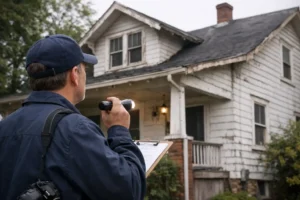
A PCR commonly evaluates readily visible roof coverings, flashings, drainage components, exterior wall finishes, windows, doors, sealants, and other elements that help keep water and weather outside. The report may note apparent age, observed wear, active leaks, previous patching, damaged materials, or areas where service records are needed to determine remaining service life.
This section is particularly valuable because deferred exterior maintenance can become expensive when moisture reaches concealed materials. High-resolution photographs and precise location references help a client understand whether an issue is isolated or repeated across the property.
The inspection is generally visual and non-destructive. Inspectors do not remove roofing materials, open walls, or dismantle equipment unless that work is specifically authorized. When visible indicators suggest concealed moisture or other concerns, advanced tools such as thermal imaging and moisture detection can help target the next step.
Mechanical, electrical, and plumbing systems
Heating, cooling, ventilation, electrical distribution, and plumbing are central to a property’s usability and operating costs. A property condition report generally records the visible condition, apparent age, accessibility, and observed operation of major components where practical.
For mechanical equipment, findings may address rooftop units, boilers, furnaces, chillers, air handlers, exhaust equipment, ductwork, controls, condensate management, and visible maintenance needs. The report may identify units approaching the end of their typical service range, signs of deferred service, or equipment that warrants review by a qualified trade contractor.
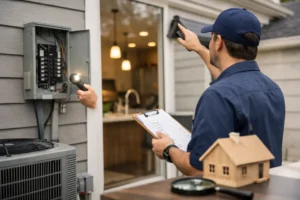
Electrical observations can include service equipment, panels, breakers, labeling, disconnects, visible wiring conditions, lighting, and apparent capacity concerns. Plumbing observations often cover supply lines, drain lines, water heaters, fixtures, valves, pumps, and visible leaks. A careful PCR does not promise that every component will function indefinitely. It documents observed conditions and highlights material risks that should influence planning.
Interiors, common areas, and life-safety features
Interior observations often cover floors, walls, ceilings, doors, stairs, restrooms, kitchens or break areas, tenant spaces, storage rooms, and accessible common areas. The focus is on visible deterioration, water staining, damage, unsafe conditions, and maintenance needs that may affect occupants or operations.
Life-safety features may include readily visible fire extinguishers, alarm components, sprinkler piping, exit routes, emergency lighting, and fire-rated assemblies where accessible. Depending on the scope, the report may also identify observable accessibility concerns. These observations are valuable, but a PCR is not automatically a formal code compliance inspection, fire protection certification, or accessibility survey. If the transaction requires those services, they should be commissioned separately.
Documentation That Makes the Report Useful
A property condition report is only as valuable as its documentation. Decision-makers should be able to trace a finding to a location, see the observed condition, understand why it matters, and determine what to do next.
A well-organized report typically provides a narrative description of the property and assessment scope, annotated photographs, observations by system or area, and a findings table. That table may classify items by urgency, such as immediate attention, short-term repair, or planned maintenance. It should also identify recommended next actions, whether that is obtaining a contractor quote, reviewing maintenance records, monitoring a condition, or completing a specialty evaluation.
For acquisitions and portfolio planning, the capital needs schedule is often the most financially useful section. It estimates anticipated costs for major repairs or replacements over a defined planning period, commonly several years. These figures are planning allowances, not contractor bids. Actual costs vary with access, market conditions, design requirements, tenant coordination, materials, and the full extent of conditions discovered during repair work.
What a PCR Does Not Automatically Include
A clear scope protects the client as much as a detailed findings section does. Unless specifically included, a PCR may not include destructive testing, environmental sampling, mold testing, asbestos surveys, radon testing, code certification, laboratory analysis, invasive moisture investigation, or detailed design specifications.
It may also rely on information supplied by the owner, manager, or client. Missing maintenance records, inaccessible spaces, locked rooms, occupied tenant areas, weather conditions, and equipment that cannot be safely operated can limit what an inspector can observe. Professional reporting identifies these limitations plainly rather than presenting incomplete information as certainty.
This distinction matters during due diligence. If a PCR identifies repeated moisture staining or equipment with an unclear service history, the appropriate next step may be a targeted specialty assessment before closing. Spending more on focused evaluation can be prudent when the potential exposure is significant.
How to Read Findings and Repair Priorities
The strongest reports make it easier to act. Start with items that affect safety, active water entry, building operations, or the potential for rapidly escalating damage. Then consider short-term repairs that could become more costly if delayed. Finally, use longer-range capital projections to inform reserves, negotiations, and asset management plans.
Do not evaluate a finding in isolation. A modest repair can carry a larger operational impact if it affects a critical tenant space, a healthcare facility, a loading area, or a building with limited downtime. Likewise, a large projected replacement cost may be manageable if it is several years away and can be planned into the capital budget.
For clients who need a clear, documented basis for a property decision, Archer Professional Inspections delivers detailed assessments with visual evidence and practical recommendations. The purpose is not to create unnecessary alarm. It is to replace uncertainty with accurate information, clear priorities, and a workable path forward.
Before you rely on any report, make sure its scope matches the property and the decision in front of you. The right PCR does more than identify visible conditions – it gives you a disciplined way to plan the next move with confidence.