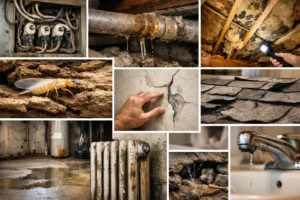
A warehouse roof failure example rarely begins with a dramatic collapse. More often, the first signs appear ordinary: a recurring ceiling stain near a dock door, water that remains on the roof after a storm, a new drip beside stored inventory, or a section of roof deck that looks uneven from below. When those signs are treated as isolated maintenance items rather than connected evidence, a manageable repair can develop into an operational emergency.
For owners, investors, property managers, insurers, and legal teams, the value of a failure investigation is not simply identifying what went wrong. It is documenting the condition accurately enough to make sound repair, maintenance, insurance, and risk-management decisions.
Warehouse Roof Failure Example: From Small Leak to Major Loss
Consider a hypothetical distribution warehouse with a low-slope membrane roof. The building has experienced several years of intermittent leaks around rooftop equipment and along a roof drain area. Maintenance personnel have applied localized patches as leaks appeared, which reduced visible water intrusion temporarily. However, the roof was not evaluated as a complete system.
After a period of heavy rain, water remained on a broad section of the roof for days. Inside the warehouse, employees noticed staining and damp insulation above a storage area. The problem became urgent when ceiling materials sagged, roof deck corrosion was observed in isolated areas, and the owner had to move inventory away from the affected zone.
A detailed evaluation found that the immediate event was not the only issue. The roof had several interacting conditions: deteriorated flashing at equipment penetrations, restricted drainage, wet insulation, aging patches, and signs of long-term moisture exposure below the membrane. Each condition mattered, but their combined effect increased the likelihood of a significant failure.
This example illustrates a common lesson: the location of the interior leak is not necessarily the source of the roof problem. Water can travel along insulation, deck flutes, fasteners, conduits, or framing before it becomes visible indoors. A report that documents only the stain can miss the conditions driving repeated damage.
Why Warehouse Roof Problems Escalate Quickly
Warehouse roofs cover large areas and often support equipment, drains, curbs, piping, and access paths. That scale creates more opportunities for small defects to become larger ones. A membrane opening at a penetration may admit water slowly for months before anyone sees damage below.
Ponding water is another frequent concern. A shallow amount of standing water may not automatically mean the roof is failing. The significance depends on the roofing material, drainage design, duration of ponding, existing deterioration, and whether water is entering the building. Still, persistent ponding deserves attention because it can accelerate membrane aging, expose weak seams, and add weight where moisture may already be trapped within roof components.
Deferred maintenance can compound the problem. A patch may be appropriate for a discrete, well-defined defect. Repeated patches across an aging or moisture-affected roof, however, can obscure the condition of the underlying system. The lowest immediate repair cost is not always the lowest ownership cost when production interruptions, inventory damage, tenant complaints, or emergency repairs are considered.
What a Thorough Roof Investigation Should Document
An effective warehouse roof evaluation should create a clear record of observations, not rely on general statements such as “roof leak present.” Decision-makers need to understand where conditions exist, how extensive they appear, what evidence supports the findings, and what actions are appropriate.
At the roof surface, the inspection should document the membrane condition, seams, flashings, penetrations, rooftop equipment curbs, drains, scuppers, expansion areas, previous repairs, and visible ponding patterns. High-resolution photographs should identify both close-up defects and their location within the broader roof area.
The interior review is equally important. Inspectors should examine accessible areas below the roof for staining, active moisture, corrosion, wet or damaged materials, sagging finishes, mold-like growth, and impacts to electrical components, storage areas, and operations. The goal is to connect evidence from the roof surface with conditions observed inside the building without assuming a cause before the facts support it.
Moisture detection and thermal imaging can add useful evidence when conditions are suitable. These tools may help identify temperature differences or elevated moisture patterns that are not obvious during a visual review. They do not replace verification, and results can be affected by weather, roof assembly, time of day, surface conditions, and access. Used correctly, they help target further testing or repairs rather than provide a shortcut to conclusions.
A strong report also distinguishes between observed facts and professional opinions. For example, “standing water was present near two drains 48 hours after rainfall” is an observation. “Restricted drainage may be contributing to recurring water exposure in this area” is a reasoned opinion that should be tied to documented evidence.
Separating the Trigger From the Underlying Cause
A storm is often blamed when a roof begins leaking or a roof area deteriorates rapidly. Severe weather may be the trigger, but it is not always the full explanation. The investigation should consider whether wind damage, aging materials, inadequate drainage, installation deficiencies, roof traffic, blocked drains, deferred maintenance, or prior repairs contributed to the event.
This distinction matters in insurance and legal matters. A sudden weather-related event may be evaluated differently from long-term deterioration or maintenance-related conditions. It also matters for repair planning. Replacing a damaged membrane section without addressing a recurring drainage issue may leave the owner facing the same problem again.
Documentation should be timely. Conditions can change after emergency drying, temporary patching, material removal, or additional rainfall. If a roof issue may lead to an insurance claim, dispute, or significant capital decision, preserve photographs, maintenance records, weather information, repair invoices, and dates when leaks were first observed. A well-organized record can clarify the timeline and reduce avoidable disagreement later.
When a Local Repair Is Enough and When It Is Not
Not every warehouse roof issue requires broad replacement. A localized repair may be practical when the defect is isolated, surrounding materials are dry and serviceable, drainage is functioning, and the roof is otherwise within a reasonable service-life range. The repair scope should match the evidence, not the anxiety created by a leak.
Broader action may be justified when moisture is widespread, patches have become frequent, interior damage appears in multiple areas, membrane deterioration is extensive, or drainage problems recur after maintenance. In those situations, a property owner may need a phased repair plan, a more detailed moisture survey, or a capital plan that weighs immediate risk against long-term cost.
Operations also influence the decision. A warehouse storing high-value goods, food products, medical supplies, or sensitive electronics may have little tolerance for recurring leaks. A facility with flexible storage space may be able to isolate an affected area temporarily. The roof condition is the same, but the business consequence is not.
Practical Steps After a Roof Concern Is Found
First, protect people and property. Restrict access beneath areas with active leaking, sagging materials, or electrical exposure, and move vulnerable inventory when it can be done safely. Temporary measures can limit damage, but they should be documented before conditions are altered whenever possible.
Next, avoid treating repeated leaks as routine work orders. Assemble prior repair records, photographs, leak locations, and dates. Patterns often emerge when this information is reviewed together. A leak that appears to move from one location to another may indicate water migration rather than several unrelated failures.
Then obtain an objective building evaluation that addresses accessible roof and interior conditions, visible evidence of moisture, drainage, prior repairs, and operational impacts. Archer Professional Inspections provides clear visual documentation and decision-support reporting so stakeholders can prioritize repairs with a defensible record of what was observed.
A warehouse roof does not need to fail dramatically to create a serious financial problem. The most useful time to investigate is when the warning signs are still specific, documented, and repairable – before a small stain becomes a shutdown, a claim dispute, or a rushed capital expense.