A roof leak shows up months after a storm. Cracks begin widening along an interior wall. Flooring starts to cup, but only in one area of the building. At that point, a quick opinion is not enough. The forensic damage investigation process is designed to answer a harder question: not just what is damaged, but why it happened, how extensive it is, and what evidence supports the conclusion.
For property owners, investors, managers, and insurers, that distinction matters. Repairing visible symptoms without identifying the actual cause often leads to repeat failures, disputed claims, and unnecessary costs. A sound investigation creates a clear path forward by combining site evidence, building science, documentation, and practical reporting.
What the forensic damage investigation process is meant to do
A standard inspection usually focuses on current condition. A forensic damage investigation goes further. It examines causation, contributing conditions, timeline clues, and the relationship between observed damage and building performance.
That matters in situations involving water intrusion, fire aftermath, impact events, construction defects, moisture-related deterioration, settlement concerns, material failure, or recurring problems that were never fully resolved. In many cases, more than one factor is involved. A storm may trigger the initial damage, but deferred maintenance, installation errors, or poor drainage may have allowed the issue to spread.
The goal is not to guess quickly. The goal is to document defensible findings that can support repair planning, insurance discussions, legal review, or internal decision-making.
How the forensic damage investigation process typically works
The exact scope depends on the property and the issue, but most investigations follow a disciplined sequence. That sequence helps prevent missed evidence and keeps conclusions tied to observable facts.
1. Define the problem and the purpose of the investigation
The first step is clarifying why the investigation is being requested. A homeowner may want to know whether moisture damage is active or old. A commercial owner may need documentation for a claim or to guide capital planning. A legal team may need an objective record of conditions and likely cause.
This stage shapes the inspection strategy. It determines which areas need close review, what background documents are useful, whether prior repairs matter, and how detailed the final reporting must be.
2. Review available history and records
Before anyone draws conclusions on site, the known history needs to be organized. That can include maintenance records, prior inspection reports, repair invoices, weather events, leak history, construction documents, photos, tenant complaints, or claim information.
This does not replace fieldwork. It gives context. A stain that appears recent may actually trace back to an earlier unresolved event. A crack that seems alarming may have been stable for years. Records help establish what changed, when it changed, and whether previous corrective work addressed the right issue.
3. Conduct a detailed site inspection
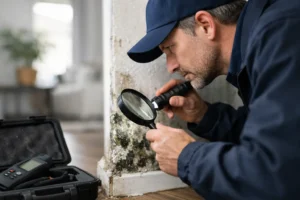
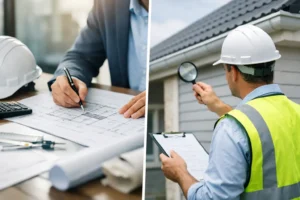
This is the core of the process. The inspection is typically systematic, beginning with broad observations and narrowing toward specific failure points. Investigators look at the damaged area, nearby building components, exterior exposure, moisture pathways, and any conditions that may have contributed to the problem.
Visual documentation is essential. High-resolution photographs, field notes, measurements, and location-specific observations create the record that supports the analysis later. In many cases, advanced tools also help verify what the eye alone cannot confirm.
Thermal imaging may reveal temperature differences that suggest hidden moisture or missing insulation patterns. Moisture meters can help distinguish active wetting from dry staining left behind by a past event. In some cases, selective testing or limited invasive examination may be appropriate, especially when surface conditions do not tell the full story.
4. Separate symptoms from causes
This is where experience matters. Water staining on a ceiling is a symptom. The cause might be roof failure, flashing defects, HVAC condensation, plumbing leaks, window intrusion, or even humidity-related condensation. Similar-looking damage can come from very different sources.
A careful investigator avoids jumping to the most obvious explanation. They evaluate whether the evidence supports a single cause, multiple contributing factors, or a chain of events. This is often where poor assumptions create expensive mistakes. If the wrong cause is identified, the wrong repair gets funded.
5. Evaluate the extent and significance of the damage
Not all damage carries the same urgency. Some conditions are cosmetic. Others affect durability, indoor conditions, safety, operations, or asset value. The investigation should clarify how widespread the issue is, whether it appears active, and what secondary damage may already be present.
For residential clients, that may mean understanding whether the issue is isolated or likely to spread into concealed spaces. For commercial stakeholders, it may involve operational risk, tenant impacts, reserve planning, or liability exposure. The right report does more than identify a problem. It helps the client understand the decision attached to that problem.
What makes a forensic damage investigation reliable
A reliable investigation is grounded in evidence, not urgency. That sounds simple, but property damage cases often come with pressure from timelines, transactions, claims, or competing opinions.
Good work depends on three things: a methodical inspection, disciplined documentation, and conclusions that stay within the evidence. When any one of those is missing, the report becomes less useful.
Documentation matters as much as observation
If findings are not documented clearly, they are harder to defend and harder to use. That is why organized reporting is central to the forensic damage investigation process. A strong report connects observations, photos, testing results, and analysis in a way that non-experts can follow and professionals can rely on.
That includes describing what was observed, where it was observed, what tools were used, what limitations existed, and how the final opinion was reached. It should also identify areas where additional review or destructive testing may be needed. Certainty has limits, and a credible investigator acknowledges them.
The answer is not always a single event
Many clients want a simple conclusion, and sometimes there is one. A fallen tree damages the roof. A supply line leaks under pressure. A vehicle impact affects an exterior wall. But in many cases, the evidence points to overlapping causes.
For example, a storm may create the opening, while older deterioration allows moisture to travel farther than expected. Poor ventilation may worsen a condensation issue that first appeared after a building use change. Deferred maintenance may not have caused the initial event, but it may have increased the resulting damage. Good analysis accounts for those trade-offs instead of forcing an oversimplified answer.
When to request this type of investigation
Some situations clearly call for more than a routine inspection. Recurring leaks, unexplained cracking, hidden moisture concerns, disputed repair quality, fire or impact damage, and insurance-related questions are common examples. The same is true when a property owner needs a documented basis for repair scope, reserve planning, or legal review.
Timing matters. Evidence is easiest to interpret before conditions change. Temporary drying, cleanup, demolition, or patch repairs can remove clues that help identify the source and sequence of damage. That does not mean an investigation becomes impossible later, but early documentation often produces a stronger result.
What clients should expect from the final report
A useful final report should leave the client with clarity, not more confusion. That means plain-language findings supported by technical reasoning, thorough photographic evidence, and practical next steps.
In many cases, the report should explain the likely cause of damage, contributing conditions, visible extent, limitations of the investigation, and recommended actions. Those actions may include targeted repairs, additional specialized testing, monitoring, or review of concealed areas. For clients balancing cost, urgency, and risk, that kind of reporting is what turns an inspection into a decision-making tool.
At Archer Professional Inspections, that level of clarity is the point. Clients do not just need information. They need organized evidence they can use with confidence.
When damage appears, the real cost often comes from uncertainty. A careful investigation replaces that uncertainty with documented facts, practical direction, and a clearer next move.