A commercial roof rarely fails all at once. More often, it gives off small warnings first – a loose seam, trapped moisture, blocked drainage, flashing that has started to separate. If those signs are missed, a manageable repair can turn into interior damage, tenant complaints, disrupted operations, and a much larger capital expense. That is why a commercial roof inspection checklist matters. It creates consistency, improves documentation, and helps owners and managers make decisions based on actual roof conditions rather than assumptions.
For some properties, the roof is easy to forget until a leak shows up on a ceiling tile. For others, especially larger facilities or multi-tenant buildings, roof condition affects budgeting, insurance conversations, maintenance planning, and transaction due diligence. In either case, the checklist is not just a maintenance form. It is a risk-management tool.
What a commercial roof inspection checklist should accomplish
A useful inspection checklist does more than ask whether the roof looks good from a distance. It should guide the inspector through the roof covering, drainage, penetrations, edge conditions, signs of moisture entry, and visible evidence of previous repairs or active deterioration. It should also create a record of what was observed, where it was found, and how serious the condition appears to be.
That last part is where many informal inspections fall short. A roof walk by maintenance staff can be helpful, but if observations are not organized and documented with photos, measurements, and location references, the information may not support repair planning very well. A thorough inspection gives decision-makers a clearer basis for action.
The exact checklist will vary by roof type and building use. A low-slope membrane roof, for example, presents different concerns than a metal roof or modified bitumen system. The principle stays the same: inspect methodically, document carefully, and connect findings to practical next steps.
Commercial roof inspection checklist: exterior roof surface
The roof surface is the starting point because it often shows the earliest visible evidence of wear, impact, movement, and deferred maintenance. The inspection should note the roof type, approximate age if known, and any sections that appear to have been repaired or replaced at different times.
Surface condition deserves close attention. On single-ply systems, that may mean looking for open seams, punctures, shrinkage, wrinkling, membrane pullback, and areas where flashing details are no longer tight. On built-up or modified bitumen roofs, the inspector may be watching for blistering, splitting, exposed reinforcement, granule loss, or failed patching. On metal roofs, panel damage, fastener issues, separation at laps, oxidation, and failed sealant become more relevant.
Foot traffic matters too. Commercial roofs often support HVAC service access, and repeated traffic can damage protective surfacing or create localized wear paths. If walk pads are missing, deteriorated, or poorly placed, that should be documented because it often contributes to premature roof damage around service areas.
Debris is another clue. Leaves, branches, loose equipment parts, and abandoned repair materials can obstruct drainage and hide vulnerable conditions. A clean roof is easier to evaluate and usually easier to maintain.
Seams, flashing, and penetrations
Leaks often begin where the roof system changes direction or has to seal around an interruption. That includes rooftop units, vents, skylights, pipe penetrations, conduits, access hatches, and parapet transitions. These are some of the most important points on any checklist.
The inspection should look for loose counterflashing, deteriorated sealant, gaps at penetration boots, patchwork repairs, unsecured metal components, and signs that previous work was done without matching the roof system properly. Even a small opening at a penetration can allow water to travel far from the original entry point, which is one reason roof leaks can be difficult to trace without disciplined documentation.
Edge metal and coping conditions also deserve careful review. If perimeter details are loose or open, wind-driven rain can exploit those vulnerabilities quickly. Small failures at the roof edge can create larger moisture problems over time.
Drainage is one of the biggest decision points
If there is one area that repeatedly turns minor roof issues into major ones, it is poor drainage. A commercial roof inspection checklist should always include drains, scuppers, gutters, downspouts, and the surrounding roof plane.
Standing water is not just a nuisance. It can accelerate membrane deterioration, increase dirt accumulation, add unnecessary loading, and signal slope or drainage design problems. During an inspection, ponding areas should be mapped and photographed, especially if staining or surface wear suggests they have been present for a while.
Drains should be checked for blockage, secure strainers, and signs of backup. Scuppers should be open and free of debris. Gutters and downspouts should be attached, functional, and draining away as intended. Overflow drainage elements should not be ignored either. They provide important clues about whether the primary drainage system is performing properly.
There is some nuance here. Not every shallow low spot means immediate failure, and not every drain with a little debris means the system is in distress. But when drainage concerns show up alongside seam issues, surface deterioration, or recurring interior moisture staining, the level of urgency changes.
The checklist should include interior evidence too
A roof inspection is stronger when it does not stop at the roof line. Interior observations often confirm whether exterior conditions are already affecting the building envelope. That makes the findings more actionable.
Ceiling stains, damaged insulation, musty odors, peeling finishes, and moisture around rooftop unit curbs can all support what is found above. In active facilities, it is also helpful to ask whether leaks appear during certain wind directions or only after heavy rainfall. Occupant reports are not a substitute for inspection, but they can help narrow the search.
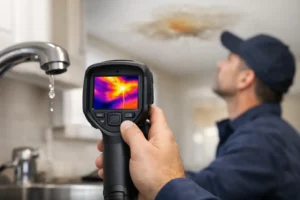
Advanced tools can improve clarity here. Moisture detection and thermal imaging may identify areas of concern that are not obvious during a visual walk-through alone. These methods do not replace a trained inspection process, but they can sharpen the report and help prioritize invasive repair verification where needed.
Safety, access, and roof-mounted equipment
Any practical commercial roof inspection checklist should account for the conditions that affect safe access and routine service. That includes ladders, hatches, guardrails where applicable, trip hazards, and clear access paths to equipment.
Roof-mounted mechanical units should be observed for curb flashing condition, condensate management, and signs that service work has damaged adjacent roofing materials. Technicians focused on equipment performance are not always focused on preserving the roof system. It is common to find unsecured panels, dropped screws, sealant smears, or damaged membrane near service zones.
Satellite mounts, solar attachments, and other add-on installations should be reviewed carefully as well. Penetrations added after original roof installation are often where quality control starts to vary.
How often should a commercial roof inspection checklist be used?
Most commercial properties benefit from a documented roof inspection at least twice a year, usually in the spring and fall, plus after major storm events. That schedule helps catch seasonal wear, drainage problems, and storm-related damage before they sit unnoticed for months.
Still, frequency depends on the building. Older roofs, facilities with heavy rooftop traffic, buildings with a leak history, and properties in severe weather regions may justify more frequent review. A newer roof under warranty may require inspections that align with manufacturer or maintenance expectations. The right schedule is not one-size-fits-all.
What separates a useful report from a basic checklist
The checklist itself is only part of the value. What matters just as much is how the findings are translated into a report. A useful roof inspection report should identify observed conditions, show where they occur, explain likely implications, and distinguish between immediate repair needs and items to monitor.
That distinction matters for budgeting. Not every issue needs emergency correction, but many conditions should not be left undocumented or deferred without understanding the risk. Clear reporting helps owners avoid two costly mistakes: overreacting to minor wear and underreacting to active failure points.
At Archer Professional Inspections, that reporting standard is central to the process. Clients need more than a checklist with boxes marked yes or no. They need organized findings, visual evidence, and practical recommendations that support maintenance planning, due diligence, insurance documentation, or repair coordination.
A commercial roof does not have to be leaking to deserve attention. The better approach is to inspect before the problem reaches the interior, before repair options narrow, and before costs start climbing faster than expected. A disciplined checklist gives that process structure, but the real advantage comes from using it consistently and turning observations into informed action.