When a building problem shows up after a storm, a leak, a fire, a settlement dispute, or a recurring performance issue, the real question is rarely just what happened. The question is why it happened, what evidence supports that conclusion, and what should happen next. That is where forensic engineering investigation services become valuable. They turn visible damage, incomplete records, and competing opinions into a documented explanation that supports sound decisions.
For owners, investors, insurers, attorneys, and property managers, this work is not about guesswork or broad assumptions. It is about methodical inspection, careful documentation, and technically grounded findings that can stand up to scrutiny. In practice, that means collecting facts on site, reviewing available records, identifying contributing conditions, and separating original cause from secondary damage, deferred maintenance, or poor prior repairs.
What forensic engineering investigation services actually cover
Forensic engineering investigation services focus on the cause, extent, and timeline of a building-related problem. The assignment may involve water intrusion, foundation movement, facade distress, roof failure, fire-related damage, impact events, construction defects, material deterioration, or moisture conditions hidden behind finished surfaces. In some cases, the issue is sudden and dramatic. In others, it develops slowly and only becomes visible after a sale, a tenant complaint, or a major weather event.
The goal is not simply to catalog damage. A useful forensic investigation connects physical evidence to a defensible explanation. That often requires more than one layer of analysis. A ceiling stain may look like a plumbing leak but trace back to roof detailing. Cracking may appear recent but reveal a longer pattern when finishes, moisture conditions, and historical repairs are considered together. Surface symptoms can mislead if the inspection stops too early.
This is why the process matters as much as the final opinion. A credible investigation typically combines site observations, photographs, measurements, moisture readings, thermal imaging when appropriate, review of plans or repair history, and a clear written report that explains findings in plain language.
When a forensic engineering investigation makes sense
Not every property issue requires specialized investigative work. If a defect is obvious, isolated, and easy to repair, a standard inspection or contractor evaluation may be enough. But some situations carry too much financial, operational, or legal risk for assumptions.
A forensic investigation is often warranted when the cause of damage is disputed, when multiple parties may share responsibility, or when the cost of the wrong repair is high. The same applies when damage has returned after previous repair attempts, when an insurance carrier needs documented cause and extent, or when an owner needs an objective basis for budgeting and next steps.
Commercial properties often reach this point faster because downtime, tenant impact, and reserve planning add pressure. Residential clients feel the stakes just as strongly when they are facing a major purchase, a claim, or a repair that could affect safety, resale value, or future maintenance costs.
What a strong investigation looks like in practice
A strong forensic assignment starts with the right question. Sometimes the question is narrow, such as whether moisture entered from above or from within the wall assembly. Sometimes it is broader, such as whether a pattern of damage reflects one incident or a longer-term condition. Defining the scope early helps keep the work focused and keeps the report useful.
Site evidence comes first
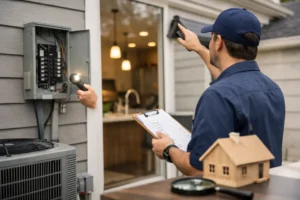
The on-site inspection is where the investigation earns its value. Visible damage matters, but so do condition patterns, material transitions, drainage paths, signs of prior repair, odor, staining, displacement, and hidden moisture. High-resolution visual documentation is essential because details that seem minor during the visit often become central during analysis.
Advanced tools can improve accuracy when they are used correctly. Thermal imaging may highlight temperature differences tied to moisture or missing insulation, while moisture meters can help confirm active or residual wetting. These tools do not replace professional judgment. They support it.
Records help build the timeline
Property history often changes the interpretation. Maintenance logs, repair invoices, photos from earlier events, lease records, plans, weather data, and claim documentation can all help establish whether a condition is new, recurring, or long-developing. In many disputes, the timeline is just as important as the physical damage.
The report should answer the next-step questions
A good report does more than describe conditions. It explains probable cause, contributing factors, affected areas, and practical implications. It should also identify where additional invasive testing or specialty consultation may be warranted. Most clients are not looking for technical language alone. They need decision-support reporting that helps them move forward.
Why cause matters more than appearance
Property problems are often repaired based on what is easiest to see. That can be expensive. Repainting over stains, replacing cracked finishes, or patching a roof section may treat the symptom while leaving the source untouched.
Cause analysis helps avoid repeat failure. If water intrusion comes from a window perimeter rather than the roofing system, the repair scope changes. If floor movement is linked to moisture conditions or material failure rather than a recent impact, the remedy and responsibility may also change. The right conclusion protects budgets, timelines, and expectations.
There is also a documentation reason to get the cause right. Insurance claims, purchase negotiations, contractor disputes, and internal capital planning all depend on a record that is clear, consistent, and technically supportable. A vague opinion is rarely enough when money or liability is on the table.
Trade-offs clients should understand
Not every investigation produces absolute certainty, and reputable firms should say so when the evidence is limited. Buildings are complex, finishes conceal damage, and prior repairs can erase clues. Sometimes the most accurate opinion is a probability-based conclusion supported by the available evidence. That is still useful, provided the limitations are clearly stated.
There is also a balance between speed and depth. In urgent loss situations, clients may need preliminary findings quickly so they can stabilize the property or respond to a claim. A more complete conclusion may require follow-up review, additional access, or selective destructive testing. The best approach depends on the purpose of the investigation and the cost of delay.
Budget is another factor. A focused investigation aimed at one defined issue is very different from a broad building failure review involving multiple systems and parties. Clear scoping at the outset helps prevent unnecessary work while preserving the quality of the findings.
Who benefits from forensic engineering investigation services
Owners use these services to understand what failed before approving repairs. Buyers and investors use them when a visible issue could change the economics of a deal. Property managers rely on them to sort out recurring complaints, document building conditions, and prioritize corrective work.
Insurance professionals and attorneys often need a report that is organized, factual, and traceable to observed evidence. Contractors and remediation teams benefit too, especially when they need a clearer picture of source conditions before proposing a repair. Across all of these groups, the common need is the same: an objective assessment that reduces uncertainty.
For a firm like Archer Professional Inspections, that means combining technical depth with practical clarity. Clients do not just need findings. They need those findings organized in a way that supports action, whether that action is repair planning, claim support, negotiations, reserve budgeting, or further testing.
Choosing the right provider
Experience matters, but not in a vague way. You want a provider that knows how to investigate building failures methodically, document conditions thoroughly, and explain conclusions without hiding behind jargon. Fast turnaround can matter as well, especially when claims, transactions, or occupancy decisions are moving on a deadline.
It also helps to ask what the deliverable will look like. Some clients need a concise cause-and-effect report. Others need a more detailed package with photos, annotated observations, moisture mapping, and repair-oriented recommendations. The right fit depends on the audience for the report as much as the property problem itself.
When the issue is complex, clarity becomes a service in its own right. A careful investigation should narrow uncertainty, not add to it. The best reports make it easier for non-experts to understand the issue while still providing enough technical support for experienced reviewers.
A property problem can be disruptive, expensive, and difficult to interpret from surface symptoms alone. A disciplined forensic investigation brings order to that uncertainty. And when the findings are clear, documented, and actionable, the next decision becomes a lot easier to make.