A commercial property can look solid on the surface and still carry expensive problems behind walls, above ceilings, or across the roof. That is why commercial building inspection services matter before a purchase, during ownership, and anytime a major repair, claim, or dispute puts the building under closer review.
For investors, property managers, lenders, and business owners, the real question is not whether a building has defects. Nearly every building does. The question is whether those issues are known, documented, and understood well enough to support a smart decision. A thorough inspection turns uncertainty into usable information.
What commercial building inspection services actually cover
Commercial inspections are broader than many clients expect. They are not limited to a quick walk-through or a short checklist. A proper evaluation looks at the condition and performance of major building systems, then connects those findings to risk, repair planning, and operational impact.
In most cases, the inspection includes the roof, structure, exterior walls, site conditions, parking areas, drainage, electrical components, plumbing systems, HVAC equipment, and accessible interior elements. Depending on the property and the scope requested, it may also include moisture intrusion concerns, evidence of deferred maintenance, life-safety observations, and signs of structural movement or damage.
The depth of the inspection should match the decision at hand. A buyer evaluating a multi-tenant retail center may need a property condition assessment that helps estimate near-term capital costs. A facility owner dealing with active leaks may need a more targeted investigation using thermal imaging or moisture detection tools. A legal or insurance matter may require a forensic approach with especially careful documentation.
When commercial building inspection services are most valuable
The most obvious time to schedule an inspection is before acquiring a property. This is often when the financial stakes are highest and the timetable is tight. Hidden problems with roofing, drainage, structural components, or mechanical systems can quickly change the economics of a deal.
But pre-purchase due diligence is only one use case. Commercial building inspection services also provide value when a property owner is building a maintenance budget, assessing storm or water damage, preparing for renovations, or responding to tenant complaints. They can also support reserve planning and help prioritize repairs based on condition rather than guesswork.
That matters because not every defect demands immediate action. Some findings are monitoring items. Others are maintenance concerns. Some are material defects with a direct effect on building performance, safety, or future cost. Good reporting helps separate those categories so decision-makers can act with clarity.
What a thorough inspection can reveal
Commercial buildings fail in predictable ways, but those failures do not always show up as obvious red flags. Water intrusion is a good example. A stained ceiling tile may seem minor, but the root cause could involve roofing defects, flashing failures, poor drainage, or condensation from mechanical systems. Without tracing the source, repairs often become repetitive and expensive.
Structural concerns can be just as misunderstood. Cracking may be cosmetic, or it may indicate movement, settlement, impact damage, or long-term moisture effects. The difference depends on pattern, location, severity, and context. An experienced inspector does not simply note the crack. They evaluate what it suggests about the building as a whole.
Mechanical and electrical issues also carry trade-offs. An aging rooftop unit may still operate at the time of inspection, but deferred replacement can affect budgeting and tenant comfort. An electrical panel may function normally while still showing signs of improper installation, deterioration, or limited serviceability. These are the details that shape real ownership costs.
Why report quality matters as much as the site visit
An inspection only becomes useful when the findings are organized in a way that supports action. For commercial clients, that usually means more than a list of observations. The report should explain what was inspected, what was found, why it matters, and what kind of response may be appropriate.
Clear visuals are part of that process. High-resolution photos help owners, partners, and stakeholders understand conditions without revisiting the site. They also create a record that can be referenced during negotiations, repairs, insurance discussions, or future maintenance planning.
Speed matters too, but speed without accuracy is not helpful. A fast report should still be thorough, readable, and technically sound. The best inspection reporting gives non-experts a clear explanation while still offering enough precision for experienced real estate and construction professionals.
One size does not fit every property
Commercial properties vary widely in age, occupancy, complexity, and maintenance history. A small office building, a warehouse, a church, a medical facility, and a mixed-use retail center all present different inspection priorities. That is why the scope should be discussed before the inspection begins.
For example, a newer building may require close attention to installation quality, drainage performance, and warranty-related issues. An older property may call for more scrutiny around end-of-life systems, structural aging, moisture intrusion, and code-era differences. Occupied buildings add another layer because inspectors often need to work around tenants, business operations, and access limitations.
The right inspection process accounts for those realities instead of forcing every building into the same format.
How advanced tools improve commercial inspections
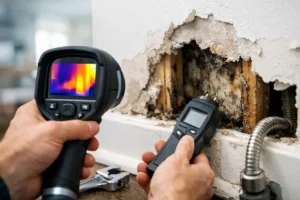
Visual inspection remains the foundation of the work, but some conditions are easier to identify with the right equipment. Thermal imaging can help locate temperature anomalies that suggest missing insulation, electrical hot spots, or hidden moisture patterns. Moisture detection tools can help confirm whether a stain is active or old, isolated or widespread.
These tools do not replace judgment. They support it. Used correctly, they help inspectors gather better evidence and reduce the chance of overlooking concealed issues. Used carelessly, they can produce misleading results. That is one reason credentials, experience, and methodology matter when choosing a provider.
Choosing a commercial inspection firm
A commercial client is not just buying time on-site. They are buying technical judgment, documentation quality, and the ability to turn observations into decision support. That means experience with commercial systems matters, but so does communication.
Ask how the scope is defined, what systems are included, what limitations may apply, and how findings are categorized in the report. Ask whether the firm can handle both routine condition assessments and more complex investigations if the inspection uncovers something unusual. Ask how quickly the report is delivered and whether the documentation is detailed enough to support budgeting, negotiations, or claims.
This is where a firm like Archer Professional Inspections stands apart. The value is not just in finding issues. It is in delivering a precise, well-documented assessment that helps clients move forward with confidence.
What clients should do before the inspection
The inspection process works best when the inspector has context. If available, provide prior reports, repair invoices, maintenance records, lease-related concerns, or known problem areas. Share your purpose for the inspection as well. A buyer evaluating risk, an owner planning capital improvements, and a manager investigating active water intrusion may all need a different emphasis.
Access also matters. Locked mechanical rooms, roof hatches, electrical rooms, and tenant spaces can limit what is evaluated. The more access arranged in advance, the more complete the inspection can be.
The real return on a commercial inspection
Some clients approach inspections as a transaction requirement. In practice, the return is much broader. Good inspections support pricing discussions, improve repair prioritization, reduce avoidable surprises, and create a stronger record of building condition at a specific point in time.
They also help teams make better decisions under pressure. That may mean renegotiating a purchase, adjusting reserves, documenting storm-related damage, or simply confirming that a suspected issue is less serious than feared. The result is the same – less uncertainty and better control over risk.
A commercial building does not need to be perfect to be a sound investment or a manageable asset. It does need to be understood. When the inspection is thorough, the report is clear, and the findings are grounded in real building knowledge, the next step becomes much easier to take.